Applied AI, Architected for AWS Production

Three end-to-end platform architectures grounded in real EFFOMA engagements — enterprise knowledge retrieval, live-event edge AI, and regulated FSI GenAI — each with a working AWS deployment and explicit design trade-offs.

NVIDIA Inception Microsoft for Startups AWS Activate Anthropic Claude Partner
Project 01 — Enterprise RAG / Agentic AI
Agentic Enterprise Knowledge Platform

A supervisor multi-agent RAG architecture productizing the pipeline template we've reused across five-plus client engagements — from a 60%-scanned-PDF Australian legal document corpus to full production evaluation tooling.

81% / 72%
BGE vs ada-002 recall, VN legal corpus
8s / 2h
Multi-agent vs manual contract review
~$350/mo
10K-document production baseline
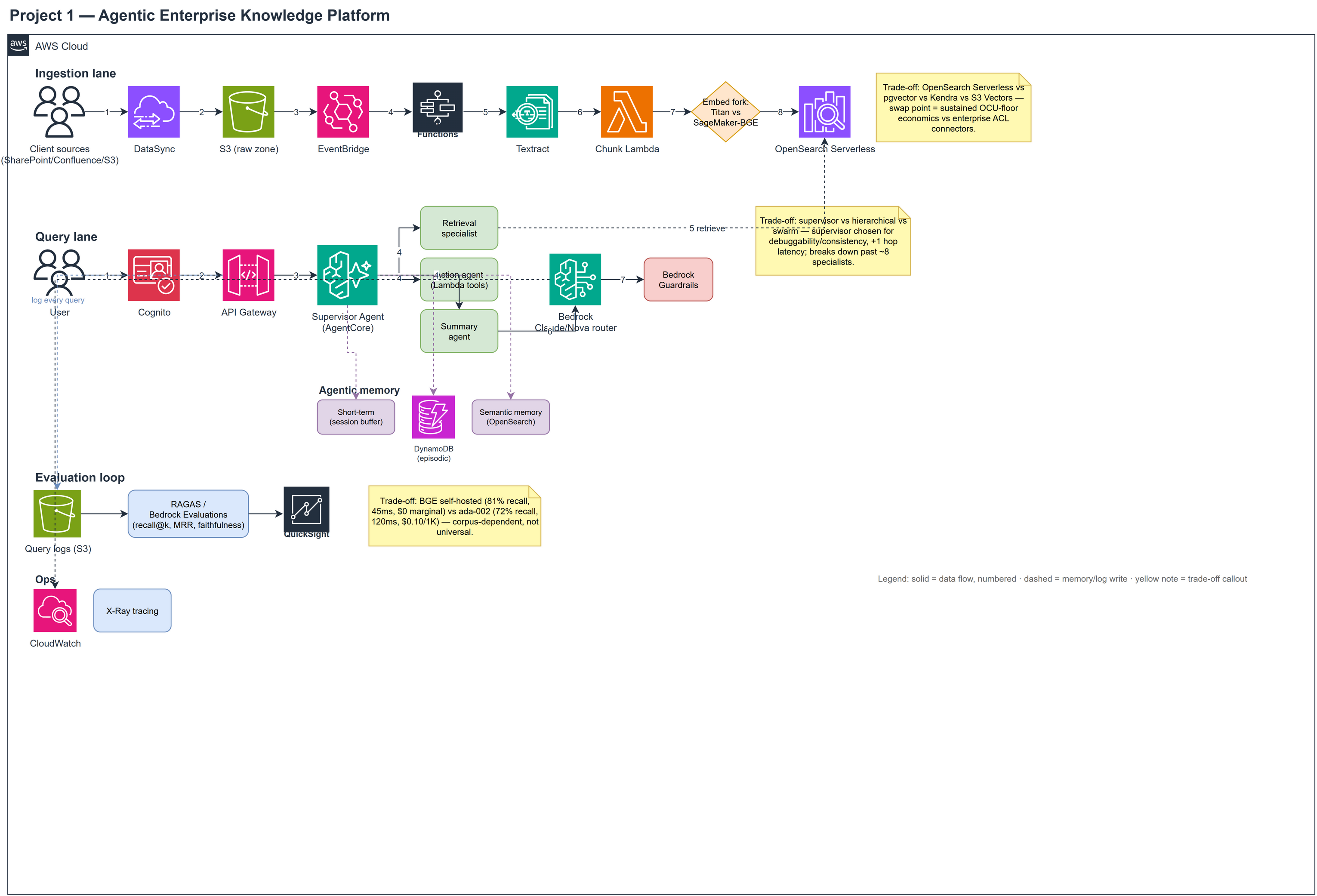
Agentic Enterprise Knowledge Platform architecture diagram

Architecture

  • S3 → Textract → Step Functions chunking/embedding pipeline
  • OpenSearch Serverless / Aurora pgvector / Kendra — chosen per scale & ACL needs
  • Supervisor agent (Bedrock AgentCore) routing to retrieval, action, and summary specialists
  • Full 3-tier evaluation: recall@k/MRR → faithfulness (RAGAS/Bedrock Evaluations) → per-layer debugging

Live demo (this deployment)

  • Aurora Serverless v2 + pgvector, Cohere multilingual embeddings
  • Bedrock Claude 3.5 Sonnet for grounded, cited generation
  • Seeded with sanitized EFFOMA case-study documents
  • Live golden-set evaluation endpoint — recall & faithfulness scored on demand
Trade-off: this demo runs Aurora pgvector at small scale — at client production scale, the swap point to OpenSearch Serverless is sustained OCU-floor economics vs. connection-pool simplicity. The architecture doc walks through eleven such decisions in full, including why supervisor topology beats swarm for enterprise debuggability at the cost of one routing hop.
Project 02 — Edge AI / IoT / Streaming

Edge AI + XR Live-Event Platform

Productizing our Melbourne White Night Festival delivery — 35,000+ visitors served with zero downtime on three weeks of build time — into a repeatable AWS platform for live-event AI experiences.

35,000+
Visitors served, zero downtime
2.3s → 380ms
Latency optimization under load
−70%
Compute cost via hybrid pre-generation
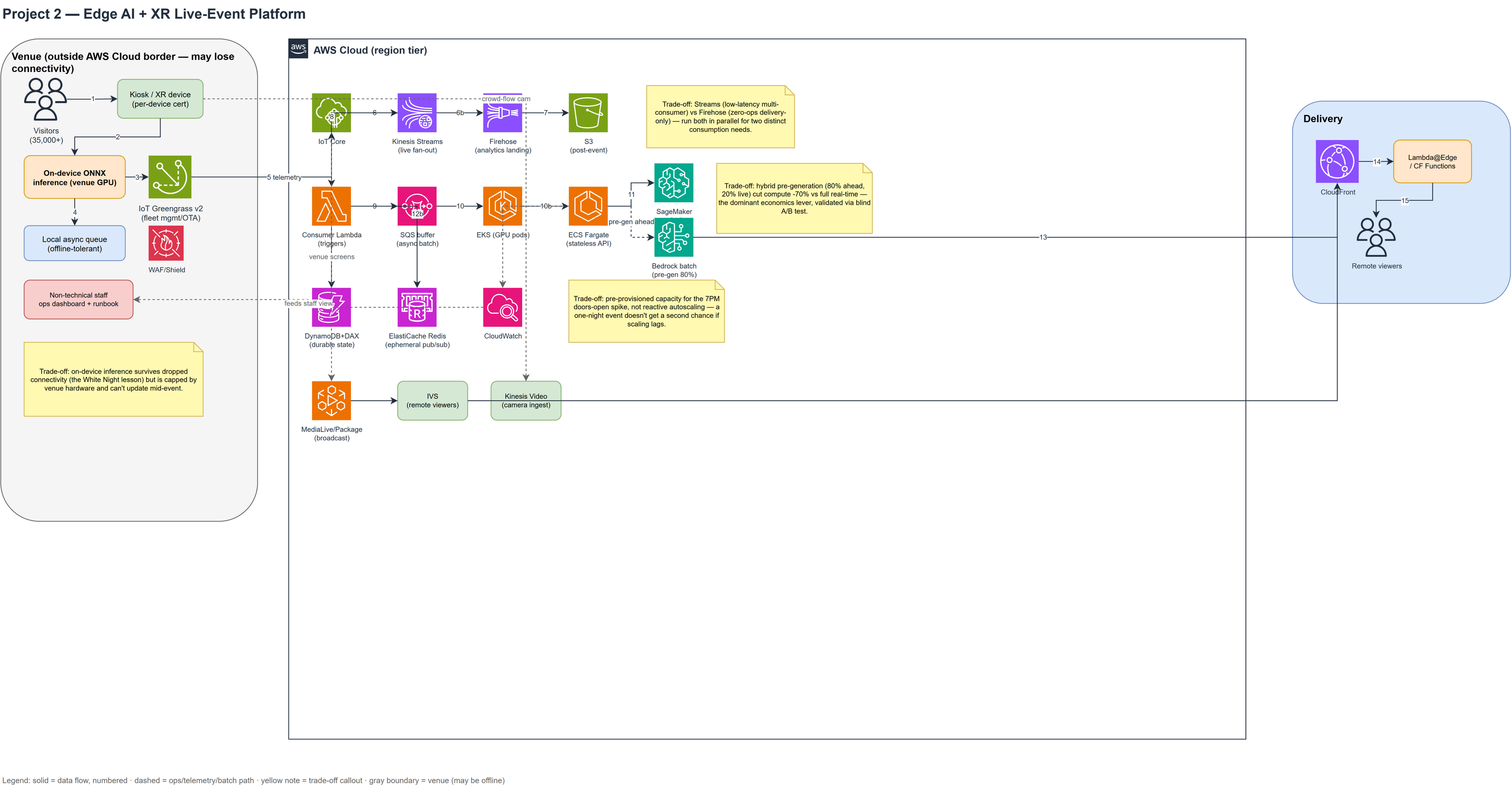
Edge AI and XR Live-Event Platform architecture diagram

Architecture

  • On-device ONNX inference + IoT Greengrass v2 fleet management (offline-tolerant)
  • Kinesis Data Streams (live fan-out) + Firehose (analytics) run in parallel
  • Hybrid pre-generation: 80% of content pre-computed, 20% generated live
  • Pre-provisioned capacity for event-day spikes, not reactive autoscaling

Live demo (this deployment)

  • Scheduled simulator replaces physical venue kiosks for this demo
  • Real Kinesis → Lambda consumer → DynamoDB hot-path aggregation
  • Live ops dashboard — the same "is it working" view built for non-technical venue staff
Trade-off: on-device inference survives a dropped venue connection — the exact lesson from the real event — but is capped by whatever hardware ships to the venue and can't update mid-event. The full architecture doc covers the inference-placement decision per component, not as one blanket choice.
Project 03 — FSI GenAI / Data Residency

FSI GenAI Banking Assistant, Vietnam Data Residency

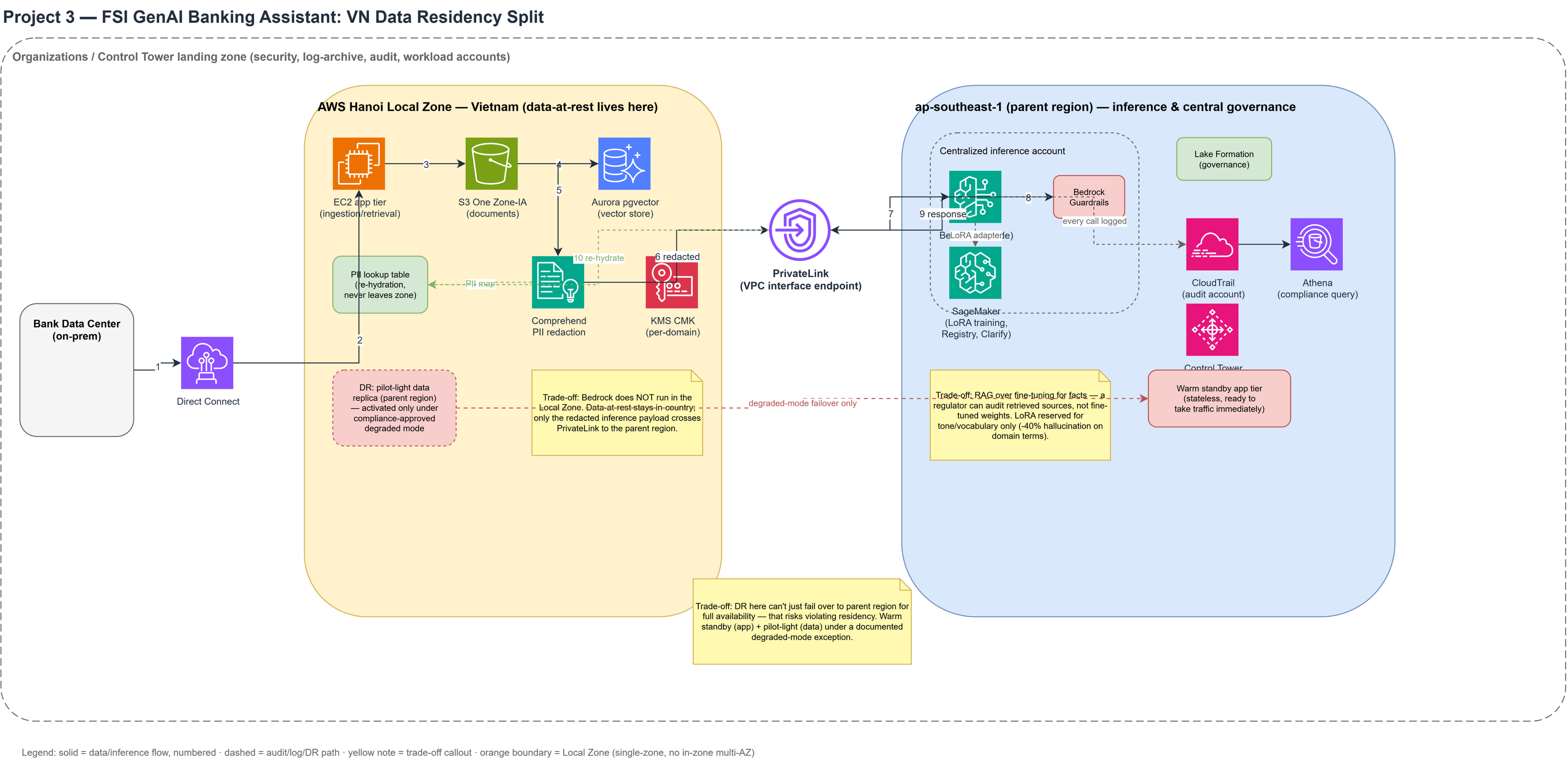
An RM-facing policy assistant architected around the real constraint that Bedrock does not run inside Vietnam's Hanoi Local Zone — data-at-rest stays in-country; only a redacted inference payload crosses PrivateLink to the parent region.

−40%
Hallucination reduction via targeted LoRA
In-country
Data-at-rest, Hanoi Local Zone
PII-redacted
Every payload before cross-region inference
FSI GenAI Banking Assistant Vietnam data residency architecture diagram

Architecture

  • RAG-by-default; LoRA reserved strictly for tone/vocabulary, never fact injection
  • Comprehend PII detection/tokenization before any cross-region inference call
  • VPC interface endpoints only — no public egress for the inference path
  • CloudTrail → Glue → Athena compliance self-serve audit query surface

Live demo (this deployment)

  • Real Comprehend PII redaction → tokenization → DynamoDB (CMK-encrypted) lookup
  • Bedrock Claude 3.5 Sonnet generation on the redacted payload only
  • Response re-hydrated with original PII after generation, never exposed to the model
Trade-off: disaster recovery here can't simply fail over to the parent region for full availability — that risks violating the same residency requirement the architecture exists to satisfy. Warm standby for the stateless tier plus pilot-light data replication, activated only under a documented, compliance-approved degraded mode, is the honest answer.